Guide: Tires, Wear & Temperature — The Winning Strategy
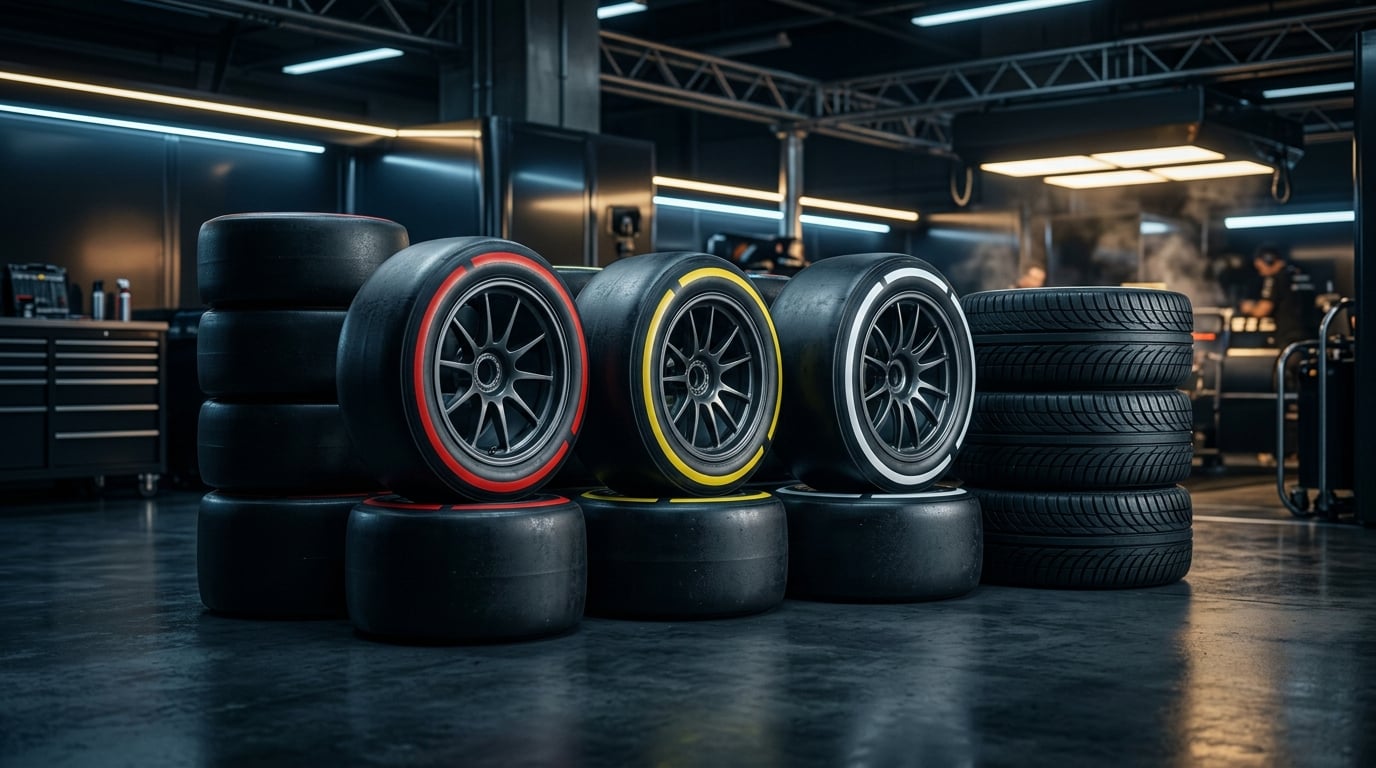
Table of Contents
The Black Gold of Motorsport
In Race Manager Online, tires are the only point of contact between your car and the asphalt. The most powerful engine and refined aerodynamics are useless if your tires are blistered, overheated, or worn down to the canvas. Understanding wear physics and thermal operating windows is the cornerstone of any championship-winning strategy.
Tire Compounds and Characteristics
There are seven distinct tire compounds in the game, each balancing speed, durability, and operating temperatures:
| Compound | Nominal Lifespan | Operating Window | Tactical Use Case |
|---|---|---|---|
| Hypersoft | 12 laps | 70°C – 105°C | Extreme qualifying pace and sprint bursts; degrades very fast. |
| Ultrasoft | 18 laps | 75°C – 105°C | High-grip alternative for aggressive short stints. |
| Soft | 25 laps | 80°C – 110°C | Fast starting stints and powerful undercuts. |
| Medium | 35 laps | 85°C – 120°C | Versatile race tire with a wide operating window. |
| Hard | 50 laps | 90°C – 130°C | Maximum durability and heat resistance; slower initial warmup. |
| Intermediate | 50 laps | 60°C – 95°C | Damp/wet tracks. Overheats rapidly on dry track. |
| Wet | 60 laps | 50°C – 85°C | Heavy rain and standing water on track. |
Factors Governing Tire Wear
Base wear per lap is determined by each compound’s lifespan, but real-world degradation is modified by several operational factors:
- Pace Mode:
- Push: Increases tire wear by +15%.
- Save: Decreases tire wear by -15%.
- Track Abrasion: Circuits with a higher track wear rating shred rubber significantly faster.
- Driver & Engineer Influence:
- High Tire Management skill saves up to 10% of tire life.
- High Aggression increases tire wear by up to +8%.
- Driver-Engineer Synergy and race engineer skill provide up to 10% in passive tire preservation.
- Driver Errors & Incidents:
- Lock-up: Instantly inflicts +8.0% permanent tire wear!
- Running Wide: Inflicts +2.0% tire wear.
- Debris Hits: Can add anywhere from +8% to +15% instant damage.
The Degradation Curve: Wear Phases and "The Cliff"
Tire degradation does not follow a simple straight line. Race Manager Online employs a non-linear degradation model:
- 0% – 70% (Working Phase): Wear scales cubically, keeping pace relatively stable. At 50% wear, time loss is only ~0.3–0.4s per lap; at 70% wear, it remains around 0.8–0.9s.
- 75% — The Cliff Edge: The critical threshold where tire grip collapses. An additional quadratic penalty triggers, causing the car to bleed 1.5 to 3.0+ seconds on subsequent laps.
- 80% – 100% (Puncture Risk Zone): Once wear exceeds 80%, an escalating puncture probability begins rolling each lap. At 100% wear, a catastrophic puncture is 100% guaranteed. A flat tire halves vehicle speed, costing 25–30+ seconds on the in-lap.
💡 Golden Rule of Strategy: Never leave a driver on track past 70–75% wear. Schedule your pit stops before falling off the cliff!
Thermal Windows: Cold Tires vs Overheating
Each compound performs best within its optimal temperature range. Straying outside this window carries immediate consequences:
Cold Tires (Underheating)
- Occurs on the out-lap or during low ambient temperatures.
- Operating below the minimum threshold (e.g., under 90°C on Hard) inflicts up to a 35% grip penalty.
- Cold rubber dramatically escalates the probability of snap oversteer spins and braking lock-ups.
Overheating Tires
- Caused by sustained aggressive pace, high track temperatures, or running wet compounds on dry tarmac.
- Grip loss from overheating is capped at 10% (~0.4–0.5s per lap). The car will not grind to a halt, but handling becomes slippery and imprecise.
- The real danger is thermal tire destruction: every degree above the maximum threshold generates progressive extra wear per second. An overheated set can burn through its entire lifespan in 12–15 laps instead of 40!
Weather & Track Wetness Dynamics
Picking the right compound in changing conditions often determines the race winner:
- 0% – 9% (Dry Track): Slicks dominate (Soft, Medium, Hard). Intermediates suffer a severe pace penalty (-1.8s) and wear out 2.5x faster.
- 10% – 37% (Damp / Drying Track): The crossover zone. Slicks begin sliding and receive penalties, while Intermediates gain grip. DRS is automatically disabled at 10% water level.
- 38% – 85% (Wet Track): The sweet spot for Intermediate tires. Slicks are entirely uncompetitive, losing 5 to 8+ seconds per lap.
- 86% – 100% (Flooded / Monsoonal): Exclusively Wet territory. Intermediates suffer aquaplaning and slicks become virtually undriveable.
Race Engineer Checklist
- Mandatory Compound Rule: If your league enforces the mandatory two-compound rule, dry races require using at least two different slick compounds (e.g., Soft + Medium or Medium + Hard). In sprints or leagues without this rule, you can complete the entire race on one compound without a pit stop.
- Engineer Plan A & Plan B: In the pre-race tire strategy dialog, your race engineer provides two calculated race scenarios. You can apply Plan A or Plan B with a single click, or tailor your own bespoke stint and pit strategy.
- Cool Overheated Tires: If tire temperatures flash into the red zone, switch the driver to economic or normal pace for a lap or two to prevent thermal wear from destroying the set.
- Watch the Weather Radar: When rain approaches, it is usually better to lose 1 second on old slicks and pit directly onto Intermediates than to execute an unnecessary dry pit stop.
Featured

Guide: Race Engineer — Free Practice, Tactics & Synergy
A comprehensive guide to race engineers in Race Manager: baseline setups in free practice, smart telemetry guidance, tactical Plan A & Plan B options, team radio, lean fuel calculations, and building driver synergy.
Top F1 & Motorsport Manager Games Online: 2026 Guide
Looking for the best online F1 and motorsport manager games? Discover how browser-based racing strategy games work, what makes real-time pit wall tactics exciting, and how Race Manager delivers an authentic multiplayer Grand Prix experience.
Guide: Track Characteristics — The Key to Winning Strategy
Every circuit in Race Manager is unique. Discover how power, aero, and handling sensitivities, tire wear, bumpiness, and DRS zones determine your optimal car setup and race tactics.